

When I was like 8 or 9 years old, I saw this movie called Time After Time, starring Malcolm McDowell and David Warner. It was a movie about H.G. Wells, Jack the Ripper and time travel. Straight blew my mind, probably mostly because all three were concepts that I had just become familiar with in school. Some 20+ years later, I ran across that movie on some cable station one day and I was mad excited. By the end, I was disappointed. Not because the movie was complete trash, but because it hit me that my mind, all these years, had remembered this movie as a cinematic masterpiece. I was just completely captured at the right time, for the right piece of entertainment. In my eyes, this is the Jordan/Lebron debate.
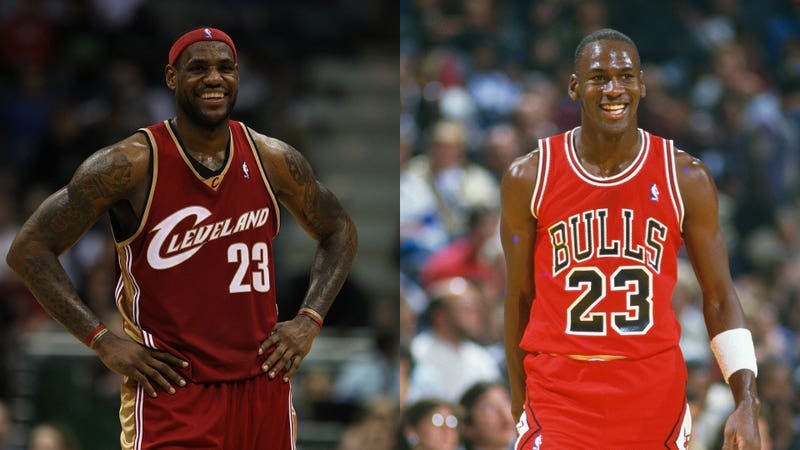
Full disclosure, and to be perfectly clear, I have absolutely no problem with anyone saying Jordan is the GOAT. It makes a lot of sense, and I actually lean towards it in a lot of ways myself. My problem is people’s need to create ahistorical, nonsensical arguments to bolster their REASON why Jordan is their GOAT.
- Jordan would NEVER allow his team to lose a playoff series. 6 for 6 baby!
- Lebron isn’t clutch. He doesn’t want the ball when it counts.
- Jordan won against better competition.
- Lebron averages so many points because the NBA babies today’s stars, and he gets so many touch fouls and free throw attempts. Jordan would average 100 points if he played today.
And these are just a few of the ways our collective memories play tricks on us. The Mandela Effect is the phenomenon describing our brains remembering an event a certain way but it turns out, that memory is completely wrong, or at least the details you though you knew 100%, were wrong. There may be no greater Mandela Effect than our memory of Michael Jordan’s basketball career. Michael Jordan was a human highlight reel. A beacon of a new, creative kind of basketball player in an era designed for the Center position to shine. He’s pretty much the blueprint for today’s NBA star. He’s also the beneficiary of some of the lousiest, goalpost moving-est, cherry picking hoops commentary we will ever see.
Watch this: Lebron cries too much, takes way too many plays off, and has a history of forcing pretty good ball players into desperation 3 point shooters as the 24 second clock winds down.
See that. Cathartic. I didn’t break anything being honest about Lebron’s weaknesses. Stop lying to me about what Jordan would and would not have done. I lived through it already. And for the love of the Lord, stop telling me who couldn’t survive the 90s. No offense, but the year Chicago won their first ring of the first 3peat, Chris Mullin and his 2-inch vertical and blazing speed held the 4th highest point total in the entire league. Reggie Miller, at a cock-diesel 180lbs was number 8. Yet, somehow I’m to believe that a 6’8, 250lb freak of nature would have trouble getting to his spots and being successful in that era? An era where Muggsy Bogues and Spud Webb had successful careers? In 1990, you have to drop below the top 10 before you even hit a Forward on the 3 pointers made list. Dominique Wilkins hit 85 3s that year. This tells me that in that era, roles were so neatly defined that it would actually be insane to watch the average Power Forward pick-up and anticipate what a KD or Lebron would do with the ball. Picture Bill Cartwright trying to guard Jokic at the 3 point line. See to me, this conversation ain’t just about Lebron. It’s about what it takes to make it to, and get minutes in the league today. Patrick Beverly and Dillon Brooks are supposed to be this eras Bruce Bowen. Both are statistically better than Bowen in just about every way that matters besides causing ankle injuries. Absorbing hard fouls and punches is cool and all, but how many points do you get for them? How does a scorer fair when there’s now zone defenses and they’re not on an island with Craig Ehlo or Scott effing Brooks.
Speaking generically, there seems to be two camps. There’s the “Players today couldn’t survive the 80s/90s” Camp, and the “Players back then were unathletic milkmen” Camp. In reality, there’s probably something valuable to take away from both of these lines of thinking.
Let’s examine both a bit. First, let’s go way back. Its March 2, 1962. The New York Knicks are playing at the Philadelphia Warriors. This would become known as the “100 Point Game”. Philly’s starting Center Wilt Chamberlain (7’1″, 260lbs) routinely scores 50+ points a game. The Knicks starting Center Phil Jordan (6’10”, 205lbs) is out hungover from the night before. Starting the game is Darrall Imhoff (6’10” 220lbs). Imhoff for his career averages 7 points and 7 rebounds a game. He’s mostly known as a good defensive player and even an Olympic medal winner. Imhoff would find himself in early foul trouble, for obvious reasons, and ultimately played 20 total minutes in the game. His backup? 6’9″, 210lb Cleveland Buckner. His eye popping averages? 6 points, 3 rebounds a game. The league at this time consisted of a total of nine teams. Teams played 80 games. This means you saw the same team anywhere between 8 and 12 times a year. There are 6 players in the entire league over 6 foot 10 inches tall. I won’t insult these gentlemen by calling them milkmen (although hoops didn’t pay, so they DID have to do something else to make money in the off season), but the more you examine games, and even the league in ’62, the more it looks less like stiff competition and more like one of those Elementary School games where the one school has the pre-pubescent 5foot11 breakout star playing against kids mostly in the 70% size percentile.

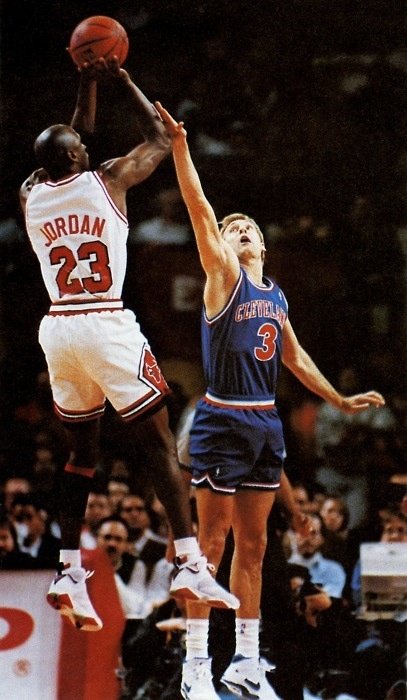
Fast forward. March 28, 1990, Jordan torches the Cleveland Cavaliers for 69 points. It’s his highest output and signature career game. Watching the game is impressive. Analyzing the game, though, is a bit embarrassing. First thing you notice is that around 30% of those points came from the free throw line. Another 50% are quick step mid-range jumpers over a much slower Craig Ehlo and a much smaller Mark Price. It’s definitely remarkable to watch him hit so many jumpers, I will admit. It’s a bit less remarkable to see how easy it is for him to get wide open each time. In ’90, Ehlo is regarded as a “competent” wing defender. He is often given the “hard guard”. It seems unconscionable that Lenny Wilkins would leave Ehlo to get smoked on an island for 4 quarters, until you remember that in 1990 shading off ball handlers is illegal. You either fully commit to a double team or you watch your boy get torched all night. Did I mention that this was a Center-centric league? Zone schemes pretty much deaded games that looked like this one, as well as the Center whose only skill was rebounding, blocking shots and clean up. Again, probably the most interesting thing about this game is the fact that he shot 23 free throws. You know, the #1 indicator people use to prove how cheap the fouls are and weak the hearts are in the game today.
In 1998, Dirk Nowitzki plays in Nike’s Hoop Heroes Tour and their Hoop Summit, propelling him to the 9th pick in the draft. Bringing his Euro approach to the league, now a 7 footer is playing the wing and consistently shooting 3 balls. Again, this isn’t so much about Dirk as it is about how team ball had to change to address him. The same would be repeated later, but framed as Shooting Range to address Steph Curry. Today, the position letter next to your name, in a lot of ways, is just a letter. Centers shoot 3s. Power Forwards run offenses. We have Point Guards that are the size of the Power Forwards in that Philly/NY game I mentioned earlier. And EVERYBODY IN THE LEAGUE CAN SHOOT.
So, on the one hand, the league has tried to make the game as Offense friendly as possible. On the other hand, it’s that much harder to get in and stay playing in the league, because the single skillset player is a dinosaur.
Now back to the Mandela effect. A common talking point is that Jordan, and even Kobe Bryant, were just far more clutch than Lebron. Generally speaking, people who make this claim are using the “Eye Test”, meaning they’re judging players by what they observe vs what the stats say. Problem with the Eye Test is Confirmation Bias and the Halo Effect. I’ll use examples to explain both. You ever want a certain car or a pair of shoes or whatever, and once you get that thought in your mind, everywhere you go, you see that car or those shoes. Well Sports analysis works the same way. If it turns out that the way Kobe approached finishing games is more attractive to you, your eyes will see the absence those elements as less effective. Example 2, and bear with me here. Stone Cold Steve Austin is one of the most famous and popular Professional Wrestlers of all time. He had the swag, the attitude, and when he came for you, he completely dominated opponents in dramatic fashion. What if I told you his official wrestling record was 823-530 and 122 draws. 3:16, as entertaining as he was, only won 55% of his matches! This is the Halo Effect. The more flashy and entertaining the player appears, the more they become perceived as better than an even more effective, productive but less eye popping player. I would suggest a combination of eyes and stats. I’ll let Nick handle the numbers on Clutch play.
All in all, I think a case can be made for Mike or Lebron as GOAT. I just think its two different arguments, and to me there’s nothing wrong with that. If you grew up on the Jackson 5, why would I expect you to say New Edition is better, and vice versa. To me, Jordan is the blueprint to the modern basketball star. Killer instinct, star power, fearlessness, unmatched branding. His effect is cultural. Lebron is the unlikely real life Frankenstein’s Monster of all basketball attributes. Bball IQ, size, passing, shooting, rebounding, all defensive first team, durability, and making OK dudes look like Allstars. One player is not supposed to be of all that. Not to mention his business and humanitarian efforts that will surely outlive him.
Want a killer who missed more shots than your brain allows you to remember? Or do you want a crybaby who values the right basketball play over heroics? I say, dealers choice. So, yeah, whatever you think…… I don’t think you’re wrong. Just stop making up dumb reasons to prove you’re right. GOAT, SHMOAT.